
The Plan Your Week Workshop
The system for women who are done letting their week run them
You know how to work hard. You know how to get things done.
But when your calendar is full, your inbox is pinging, your team needs you and life is happening around you, even the best-laid plan can disappear before 10am.
Plan Your Week gives you a simple system for deciding what actually matters, making space for it and knowing what to do when the inevitable interruption arrives.
When you were building this career – aiming for the promotion, taking on more responsibility, building a life and a family – you weren't exactly picturing spending your days feeling ruled by the things you haven't done.
You know how to work hard – you've probably been rewarded for it your entire career.
So when your week starts getting away from you, your instinct is to work longer, answer faster, multitask, keep checking your inbox and find a better planning system.
But look at how many years it's been.
If that was going to work, don't you think it would have worked by now?
That's not on you. You've just been trying to solve the wrong problem.
Right now you're...
Planning your workouts, planning family time, planning to eat well and get on top of work.
And somehow by Friday night you're on the couch with a bottle of Pinot, staring blankly at your phone while your brain keeps looping on work and wondering what the hell happened to the last week.
You wake up Monday feeling hopeful and you know what needs to happen.
Then your calendar fills up – six new meeting invites land. Someone needs a decision. A client escalation comes in. Your inbox keeps growing.
You feel like you're checking things off all day, but you're never getting ahead of the work that actually matters.
You've tried every planner on the market. You've tried getting up early to work at 5am. You've tried doing more, faster.
And yet… here you are, still feeling behind.
That's because the tools will never work until you understand your brain.
| The Panicking Brain | The Planning Brain |
|---|---|
| Operates in panic mode. Treats an email notification and a daycare call with the exact same level of urgency. | Systematically prioritises based on long-term goals, separating actual fires from noise. |
| Plans a "fantasy version" of the week assuming 0 interruptions and 40 open hours of pure focus. | Acknowledges your actual energy levels and bakes in a tight "Plan B" for when your execs go sideways. |
Your panicking brain has probably been planning your week for you.
It's trying to keep you safe by responding to whatever feels most urgent right now – but that's a terrible way to run a busy week.
Your planning brain – the part of your brain responsible for deliberate decisions, prioritising and thinking ahead – is the one you want in charge.
It knows the difference between urgent and important. It knows how long things actually take. It knows you can't do everything today. And it can account for the fact that something unexpected will inevitably land at 4pm.
Plan Your Week teaches you how to put that brain back in charge.

Introducing The Plan Your Week Workshop
The planning system for the woman who’s done feeling behind
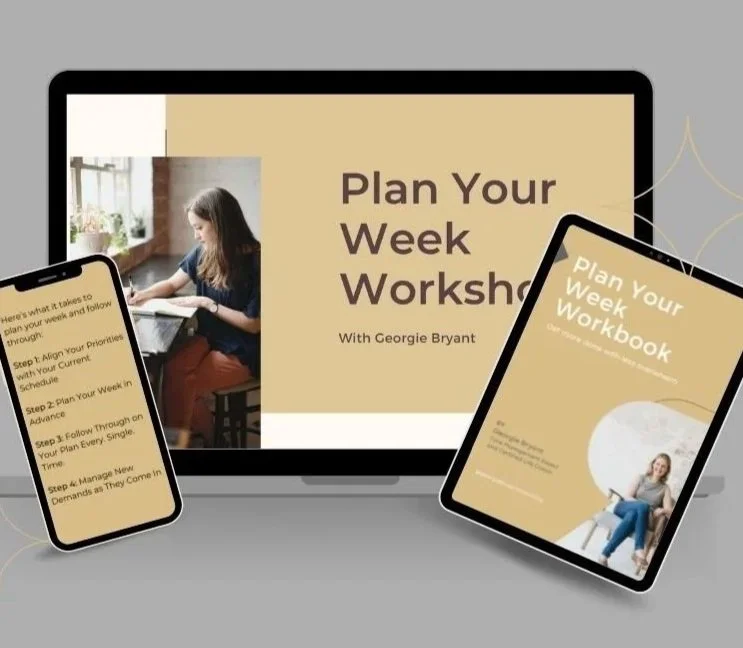
The 30 minute workshop that teaches you how to plan your week so your planning brain is running it, not your panicking brain. One method you’ll repeat every Sunday, so you know what matters before everyone else starts asking you for things.
This is for you if:
You're a capable, high-achieving professional woman who has tried every planning system out there and is still ending the week wondering where it all went. You don't want a complicated system, bullet journal or a three month course. You want something simple that works, this weekend.

WHAT’S INSIDE:
Part 1: From Overwhelm to Awareness
Before you can plan your week, you need to see what's actually going on. We start by getting everything out of your head – every task, demand, meeting and commitment – and onto one list your planning brain can actually work with.
Part 2: Your 3 Step Weekly Reset
This is the exact process I use every Sunday, and the one I've taught to over 1,000 women who felt exactly how you do right now. You'll create a real plan for the week ahead – one that accounts for your actual workload, your energy and the interruptions you know are inevitably coming.
Part 3: Follow Through Without the Struggle
Planning the week is one thing. Actually following through is where most people fall over – because your panicking brain will show up Monday morning with a very convincing reason to abandon the plan because of an urgent email, a meeting request or a work fire. This is where we sort that out so your plan survives a real week.
Plus: The Plan Your Week Workbook – the fillable workbook you can use every single week to keep you on track.
And lifetime access, so you can come back to it whenever you need a reset.
This workshop gives you the system. 1:1 coaching gives you me, every week, applying it to your actual life.
Meet My Client
She's a senior marketing manager, mother of two, and every Sunday night she used to open her laptop "just to get ahead" — and end up spiralling through her inbox for an hour, no closer to a plan, just more anxious about the week than when she started.
She went through the exact 3 step reset from this workshop on a Sunday afternoon. Twenty minutes, one notebook page and her calendar.
By Wednesday that week she DMed me:
"I actually knew what I was doing today before I even opened my laptop."
She's kept the same ritual every Sunday since. It's the one thing that's actually worked.
What other women say:
"Before the Plan Your Week workshop, my husband and I had really fallen out of routine. We did the workshop together on a Sunday night and both felt really positive about having our weeks planned out. It really felt like we were in it together as we headed into the week. We both noticed we had much better weeks at work that week too. We even planned in doing our teeth whitening — and as the calendar reminder came up, it felt so good ticking it off. I no longer feel frazzled or like the wheels are falling off by mid-week. This has become our Sunday night ritual over a cup of tea." — Hannah O'Kane
"I've gotten so much worry and stress out of my brain since starting this planning process." — Kate McKenna
Hi, I'm Georgie Bryant.
For a decade, I've coached women who are brilliant at their jobs but feel like they're constantly chasing their tails.
Before becoming a coach, I spent years leading teams across publishing and IT – I know exactly what it's like to be the most capable woman in the room who still can't get on top of her own week.
Over 1,000 women have used this method to go from Sunday dread to actually looking forward to Monday.
It's not magic – it's learning to put the right part of your brain in charge of the planning.

And if you're thinking, “I don't have time for this right now” — I get it.
That's exactly why this is 30 minutes.
You're not adding another productivity system to your life. You're spending 30 minutes deciding what actually matters, planning around your real commitments and creating a week you can actually follow.
The goal isn't to fit more into your week. It's to stop wasting your time reacting to everything that arrives.
If your week has been running you lately, this is your reset.
30 minute workshop
fillable workbook
personal coaching call
lifetime access
